Mike Milo and Cissy Brewer’s intimacy, care, and friendship
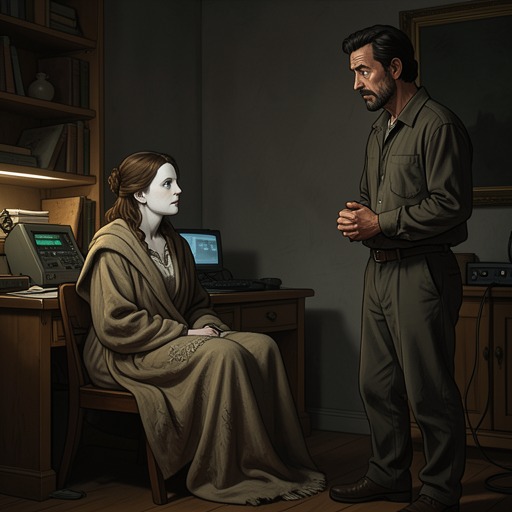
Cry MachoMike Milo and Cissy Brewer’s intimacy, care, and friendship grow from a relationship that Cissy Brewer initially defines in commercial terms, then deepen as Mike Milo recognizes that her obscured past is not a calculated secret but something she cannot remember. He becomes one of the few people who keeps seeking her out, even when she no longer knows who he is. Their connection therefore moves between affection and practical care, while remaining shadowed by the violence Cissy Brewer survives and by Mike Milo’s own unresolved grief.
Meeting and the terms of intimacy
About two weeks after Donna went to Nevada for the divorce, Cissy Brewer appeared at the Red Rio Bar, where Mike Milo was drinking after rodeo performances. She was young, cheerful, and warmly attentive, and Mike Milo liked being with her. Cissy Brewer liked him in return, but made clear before their first sexual encounter that affection would not cancel payment. Her directness established an unusual balance: she could feel fondness and imagine love while still insisting that her work had a price.
That distinction matters to their bond. Mike Milo’s companionship was not presented as a rescue from her working life, and Cissy Brewer did not offer him an idealized romance in its place. Her manner could be charming and generous, but she set boundaries, including refusing some men and keeping them from access to her past. Mike Milo was curious about her, and she tolerated his questions even when he was drunk. Their intimacy rested on this mixture of personal warmth and acknowledged transaction rather than on a claim that affection made the transaction disappear.
Memory, vulnerability, and recognition
Cissy Brewer’s inconsistent accounts of her origins, marriages, and children first make her seem deliberately elusive. Mike Milo eventually understands that the contradictions are not a performance designed to mislead him: she herself does not know her past, because she cannot remember it. She describes having recovered through her own resolve, without the treatments and interventions she recalls others trying. The account presents her pride in that recovery alongside its cost: she has learned to live without a history, but cannot reliably use that history to orient herself or protect herself.
Her difficulty recognizing rancor leaves her exposed to Ewell Macmillan’s hostility after she rejects him and laughs at him. Mike Milo does not understand the danger either, and joins Cissy Brewer, Ewell Macmillan, and two companions on a trip into the countryside. When the group turns against her, Mike Milo fights to intervene; the episode ends with both of them badly hurt. At the later trial, Cissy Brewer can clearly recall only that Mike Milo kept shouting in protest. Ewell Macmillan shifts blame onto his absent companions, and the penalties are limited: Mike Milo is fined, while Ewell Macmillan receives a suspended sentence. This episode makes Mike Milo’s care consequential but not protective enough to prevent lasting harm.
Searching and everyday care
After the trial, Cissy Brewer disappears. Rumors about her whereabouts circulate, but Mike Milo continues looking for her because he believes she needs help and cannot manage distance. He finds her by chance beside Route 73, living in the boarded-up remains of a roadside hot-dog stand. At first she does not recognize him. During his sporadic visits, she sometimes recovers fragments: his name, the Red Rio Bar, or things he once told her. Their relationship is thus repeatedly interrupted by the same uncertainty—whether the person before him can remember that they have shared a life at all.
On one visit, Mike Milo identifies himself as Mike, but the silence that follows tells him she has not remembered him. He begins to leave; then Cissy Brewer invites him inside. The moment does not erase her impairment. When Mike Milo gently asks whether she knows she needs to wash, she answers agreeably, but he realizes that she does not understand the need. He considers contacting the Welfare Department, yet remembers that she was terrified by the prospect of being put away. His dilemma is practical as well as emotional: he wants to help, but cannot be certain that intervention would make her safer. The care between them takes the form of attention to ordinary needs, without an easy solution to her dependence or his uncertainty.
Tenderness, grief, and the shape of care
Their closeness also includes a moment of intimacy in which Mike Milo speaks gently and Cissy Brewer responds with a peaceful smile. Afterward, he returns to his car and finds himself unable to move or cry. The stillness recalls the period after Laurie died, and he fears that another lost year may follow. He refuses that conclusion, trying to understand grief as something from which a person must learn. Cissy Brewer’s presence offers tenderness, but it does not function as a cure for his bereavement; their contact opens feeling in him while exposing how readily affection can lead back to loss.
Later episodes in Mexico provide a contrast in how Mike Milo handles material exchange, though they do not depict further contact with Cissy Brewer. After Macho wins a cockfight, Mike Milo keeps only the hundred pesos he contributed and gives the remaining betting proceeds to Rafo. When Porfirio explains that the money is bound up with the livelihood of Marta, a widow with four children, the scene complicates generosity: money that looks like a prize to one person may represent another family’s means of survival. In a separate moment, when Mike Milo and Rafo have only eight pesos left, food arrives in a large earthenware pot, sent by Marta. Rafo wants to return the pot not to seek another meal but to express thanks, and asks Mike Milo to learn the Spanish phrase for thanking her. These scenes do not resolve the difficulties of Mike Milo and Cissy Brewer’s relationship. They do, however, echo its central tension between payment, need, and personal feeling: care becomes meaningful through attention to what another person needs, but it cannot guarantee control over the other person’s circumstances or memory.